The court
Body held. Language formal. Time measured. Desire forced into straight lines.
An international ensemble creating actor-led, multilingual Shakespeare by freeing the imagination from the literal.
We create Shakespeare through precise provocations—clay, found text, movement, rhythm, sound and breath—that release the actor’s imagination and allow each play to reveal its own physical and vocal world.
We work across gender, ethnicity, and language, free of inherited assumptions about who may embody a role. We’re interested not in fitting an actor to a preconceived idea of the character, but in discovering the character through what that actor brings.
Our name comes from Puck’s delighted verdict: “Lord, what fools these mortals be!” However vast Shakespeare’s worlds become, their scale is human.
These Mortals is now a Community Interest Company, incorporated on 12 October 2026. This gives our shared practice a lasting home: a company working for community benefit through theatre and creative learning.
Alongside productions such as WOOD, our work includes acting and voice workshops, Chekhov scene study and bespoke showreel scenes. We bring writing, rehearsal and performance together to help actors develop their craft and share their work.
Income supports the work, including fair payment for the people delivering it. Any surplus is reinvested in the company’s community purpose.
Download company CVA Midsummer Night’s Dream
Five actors. Seventy minutes. An empty space. A forest made from rhythm, sound, breath and silence.
wood /wʊd/ adjective · archaic Mad; out of one’s mind. noun A forest.
The play has an irrepressibly funny spirit and a dark undertow. Hermia faces death. Desire becomes possession. Lovers humiliate one another. Bottom is transformed, adored and discarded.
This is not a decorative fairy tale, but an anatomy of love at its most human: tender, ridiculous, erotic, irrational and cruel.
Body held. Language formal. Time measured. Desire forced into straight lines.
Bodies release. Languages multiply. Time bends. Identity becomes fluid.
The lovers’ quarrel
The performance begins in English. As love drives the characters into the wood, English fractures into the performers’ own languages—and then into rhythm, sound, breath and silence. In the lovers’ quarrel, misunderstanding becomes physical, musical and very funny, with danger still visible underneath.
The audience can no longer rely on words alone. It reads movement, rhythm, sound, breath and silence; it recognises longing, jealousy, humiliation and wonder before every word is understood.
The forest is where we lose and find ourselves.
It is made through attention: one actor’s sound, breath or movement is answered by another. Every space and audience creates a different wood.
Our work frees the actor’s imagination from the literal through precise conditions for discovery, never a finished interpretation.
A partner, a target, an object, a threshold, a place, a sound, a rhythm, music, or a word.
We play before we analyse. Imagination over intellect.
The ensemble discovers a physical and vocal language particular to this play.
Our work begins outside the actor: with a partner, target, object, material, place, sound or rhythm. Drawing on Declan Donnellan, Monika Pagneux, Anne Bogart, Complicité and Filter, we ask where a word comes from, what provokes it, and how sound and rhythm become action.
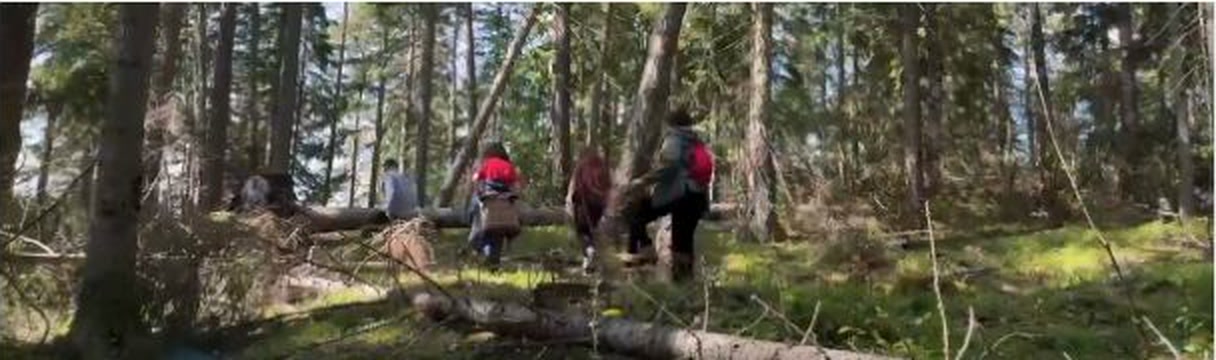
At Norra Backen, lines from the play were tied to trees. The actors found fragments, gathered a vocabulary, improvised, failed and discovered scenes. We set aside received meanings—not to empty the text, but to let it reveal itself. Imagination leads; intellect follows, testing and shaping what has been found.
Often the actors learn every line by rote before rehearsal—not to fix a reading, but to put the words fully inside them. Freed from the page, they can listen, play and be changed in the moment. The actor becomes master of the text, rather than the text mastering the actor.
The practice also carries Paul Brennen’s work with Filter Theatre and Sean Holmes—now Associate Artistic Director at Shakespeare’s Globe—on Twelfth Night and Three Sisters: trust in the actor, live listening, ensemble play and theatrical economy. Each play is minted anew through these performers, this space and this audience.
These Mortals is new. Its shared language has been tested across three countries, four Shakespeare plays and performers from across the globe since 2024.
Paul and Joe begin their intensive collaboration with a question: where do words come from, and how do they become action in performance?
The first Midsummer investigation with an international ensemble: clay, poetry, place, mother tongue and visible transformation, accompanied by Tattie Chater Davies’s original soundscape.
A five-day international laboratory deepens the relationship between language, embodied voice, partner and space.
Ongoing professional development through Shakespeare scenes, new writing, embodied voice and ensemble practice.
A workshop in releasing the actor through imagination and through the acoustics and rhythm of the scene and language.
A second week-long laboratory led by Paul, Joe and Giaele, culminating in a public sharing and the foundations of WOOD.
Performance, voice and movement meet in one shared enquiry.
Actor · director · writer · teacher
Paul is an actor, director, writer and teacher. His theatre work includes Cheek by Jowl’s The Duchess of Malfi and Troilus and Cressida, and Filter Theatre’s Twelfth Night and Three Sisters. He has performed in more than twenty Shakespeare plays at Shakespeare’s Globe, in the West End, New York and internationally.
Paul’s BBC Radio 4 writing includes The Taxman, for which he received a Sony Award, and he has worked as a Shakespeare editor for Radio 4. His stage adaptation The Loneliness of the Long Distance Runner received Fringe awards for writing and directing. His practice is strongly informed by his work with Declan Donnellan and by The Actor and the Target.
Voice teacher · practitioner
Joe is an internationally recognised voice, speech and dialect coach. Trained at Bristol Old Vic Theatre School and the Royal Central School of Speech and Drama—where he later led Voice Studies—he was Lead Voice at RADA.
Joe coaches actors for stage and screen and mentors practitioners across the UK, Europe, the US, Australia and the UAE. His work connects breath and acoustics to impulse, body, imagination and relationship. He is also a Global Ambassador for META; recent work includes voice practice on Than Hussein Clark’s Mother Has Arrived.
Movement director · choreographer · performer
Giaele is a London-based movement director and performer. She holds an MFA from the Royal Central School of Speech and Drama and a BA (Hons) from London Contemporary Dance School.
Grounded in animal movement, sacred dance and devised physical theatre, Giaele’s practice brings expressive movement into dialogue with Commedia dell’Arte, mask work and puppetry. She collaborates on theatre productions and leads research-driven performance workshops, keeping physical precision and imaginative discovery alive together.
Performers · audiences · venues · supporters
For performers
Tell us about your practice and ask about forthcoming workshops, residencies and performance opportunities.
Get involved as an artistFor audiences
Watch the research trailer and follow the production as it moves from two years of exploration towards performance.
Watch the trailerFor venues & supporters
We welcome conversations with festivals, venues, funders and partners interested in programming or developing the work.
Start a conversation